Let's cut straight to it.
You want to switch to Framer. You're worried about your Google rankings.
And honestly? That's a smart question to ask before you migrate, not after.
The short answer: migrating to Framer does not hurt your SEO.
A bad migration does.
The platform isn't the problem.
What you do (or don't do) during the move is. Poorly managed migrations cause 10–30% organic traffic drops in the first month.
Some sites take 6–12 months to recover. A few never do.
But done right? Many sites see better rankings after switching, because Framer's clean code and global CDN infrastructure outperform the plugin-bloated setups they left behind.
Here's everything you need to know — every scenario, every risk, every fix.
Before that, here's a word from our sponsor:
🚨 Why pay $79–$129 for just one template…when you can get 30+ templates for less? Most “premium” templates lock you into one layout, one style, and zero flexibility. With Pentaclay, you get an ever-growing library that gives you freedom to build websites your way—without extra cost. ✨ What’s inside Pentaclay: • 30+ Framer & Figma templates • 5–7 new templates added every month • Unlimited commercial licenses • Lifetime access available • Priority support
What Actually Controls Your SEO Rankings (It's Not Your Platform)
First, gefore worrying about migration, understand Framer's SEO fundamentals.
Next, let's talk Framer SEO migration specifics and kill a common myth.
Your SEO doesn't live inside WordPress, Webflow, or Squarespace.
Google is completely platform-agnostic. It doesn't care who built your site.
What it does care about:
Your domain's accumulated authority
The specific URLs that have earned backlinks
Your page content and target keywords
Technical signals: page speed, mobile experience, Core Web Vitals
Your metadata: title tags, meta descriptions, heading structure
That's it. Carry those across correctly, and your rankings move with you. Lose one, and you'll feel it within weeks.
Is Framer Good for SEO? (What the Platform Gives You Out of the Box)
Here's something that surprises people: Framer has a genuinely solid SEO foundation built in by default.
What Framer gives you automatically. No plugins needed:
Clean, semantic HTML output with correct H1–H6 hierarchy
Auto-generated XML sitemap at
/sitemap.xmlAuto-generated
robots.txtFree SSL certificate on every site (HTTPS out of the box)
Global CDN hosting for fast load times worldwide
WebP image optimisation served via CDN
Mobile-responsive layouts by default
Custom meta titles and descriptions for every page
Open Graph image support for social sharing
JSON-LD structured data support via custom code injection
301 redirect manager built into Site Settings (Pro plan and above)
No Yoast. No RankMath. No plugin stack to maintain or update.
Compare that to a WordPress site running Elementor, five SEO plugins, and a caching layer — Framer produces significantly cleaner HTML. Google's crawlers parse it faster. That matters for both indexing speed and Core Web Vitals.
So yes. Framer is good for SEO. The migration itself is where things can go wrong.
The 6 Real SEO Risks When Migrating to Framer (And How to Fix Each One)
Risk 1: Changing URLs Without Setting Up 301 Redirects
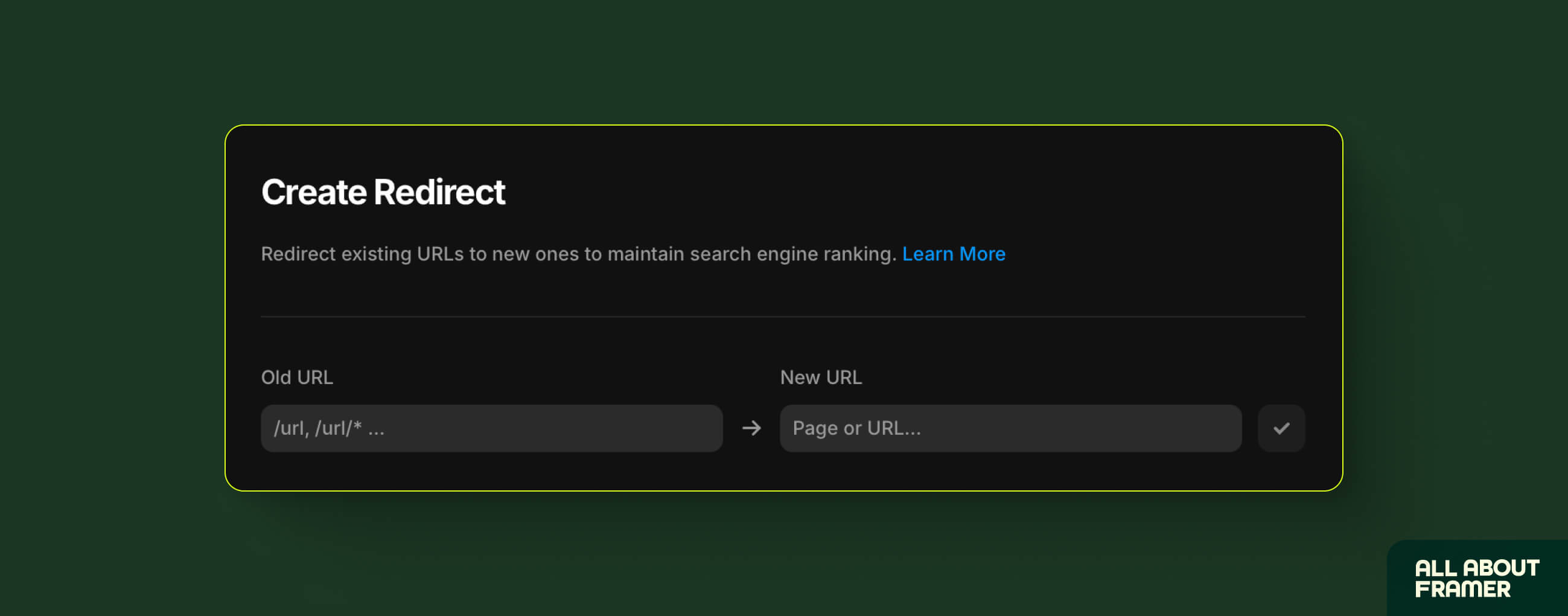
This is the single biggest SEO killer in any website migration. Not just Framer.
Every URL on your old site has built up something: backlinks pointing to it, crawl data, indexed ranking signals accumulated over months or years.
Change that URL without redirecting it and you've created a 404 error. Google treats that page as deleted.
The authority it held? Gone. The backlinks? Wasted.
The fix: 301 redirects.
A 301 is a permanent redirect. It tells Google: "This page moved here permanently." It passes the ranking authority from the old URL to the new one, preserving your link equity.
Framer has a built-in redirect manager under Site Settings → Redirects.
One critical caveat:
301 redirects in Framer require the Pro plan or above. They're not available on the free plan or Basic plan.
If you're migrating a site with existing rankings and can't access redirects, upgrade first. A $45/month plan is cheaper than 12 months of lost organic traffic.
For large sites with hundreds of URL changes: use Framer's wildcard redirect support. A single rule like /blog/* → /articles/* handles an entire URL section without creating hundreds of individual redirects.
What to do before you migrate:
Export every URL from your current site (use Screaming Frog, Ahrefs, or Google Search Console)
Identify which pages have backlinks and organic traffic. These are your priority
Rebuild those pages in Framer with the exact same URL slugs wherever possible
For any URL you can't match exactly, set up a 301 redirect from old → new
Same URLs = zero redirect needed = zero risk. That's always the goal.
Risk 2: Losing Your Metadata During the Move
WordPress sites using Yoast SEO or RankMath have metadata managed automatically. Title tags, meta descriptions, image alt text — all stored in the plugin.
When you move to Framer, none of that carries over automatically. You start with a blank slate.
If you forget to add meta titles and descriptions, or let Framer's default site-wide title populate every page, you'll have duplicate metadata across your site.
That's a direct ranking signal you're throwing away.
Another gotcha: Framer appends your site name to CMS page titles by default.
If you don't customise this, every blog post title ends up as "Post Title | Site Name | Site Name" — bloated, messy, and bad for click-through rates.
The fix:
Before migrating, crawl your old site with Screaming Frog and export a full metadata CSV (title tags, meta descriptions, H1s, alt text)
For every important page in Framer: set a custom page title (primary keyword + brand, under 60 characters) and a meta description (include your target keyword, under 155 characters)
For CMS blog posts: map your dynamic page title and description fields to pull from your CMS collection fields, so every post gets unique metadata automatically
Set OG images for key pages (affects social sharing CTR, which is a soft ranking signal)
This step is the most forgettable one in any migration. Don't skip it.
Risk 3: Framer Animations Tanking Your Core Web Vitals
This is the Framer-specific SEO risk. And it's real.
Framer makes it effortless to add beautiful animations.
Scroll effects, fade-ins, parallax, entrance animations on every section.
That's one of the main reasons people move to Framer.
But those animations, if applied carelessly, will tank your Core Web Vitals — the performance metrics Google uses as a direct ranking factor.
The three metrics that matter:
LCP (Largest Contentful Paint): How fast the biggest visible element loads. Google wants under 2.5 seconds.
INP (Interaction to Next Paint): How fast the page responds to interaction. Google wants under 200ms.
CLS (Cumulative Layout Shift): How much the page layout shifts while loading. Google wants below 0.1.
Here's where Framer sites commonly fail:
LCP problem
You apply a scroll animation or entrance effect to your hero heading.
That element can't register as "loaded" until the animation triggers.
LCP can jump from a healthy 0.8s to a failing 4.2s overnight. Rankings drop.
CLS problem
Elements that animate in from off-screen, or images without defined dimensions, cause the page layout to visibly shift while loading.
Google sees instability and penalises accordingly.
INP problem
Too many concurrent heavy JavaScript-driven interactions all loading at once.
Framer's own documentation acknowledges this: heavy animations delay LCP, and applying scroll effects to your primary heading is a known performance pitfall.
The fix:
Never apply entrance or scroll animations to your hero heading or main hero image. These are almost always the LCP element
Set explicit dimensions on all images (prevents CLS)
Use animations strategically in lower page sections, well below the fold
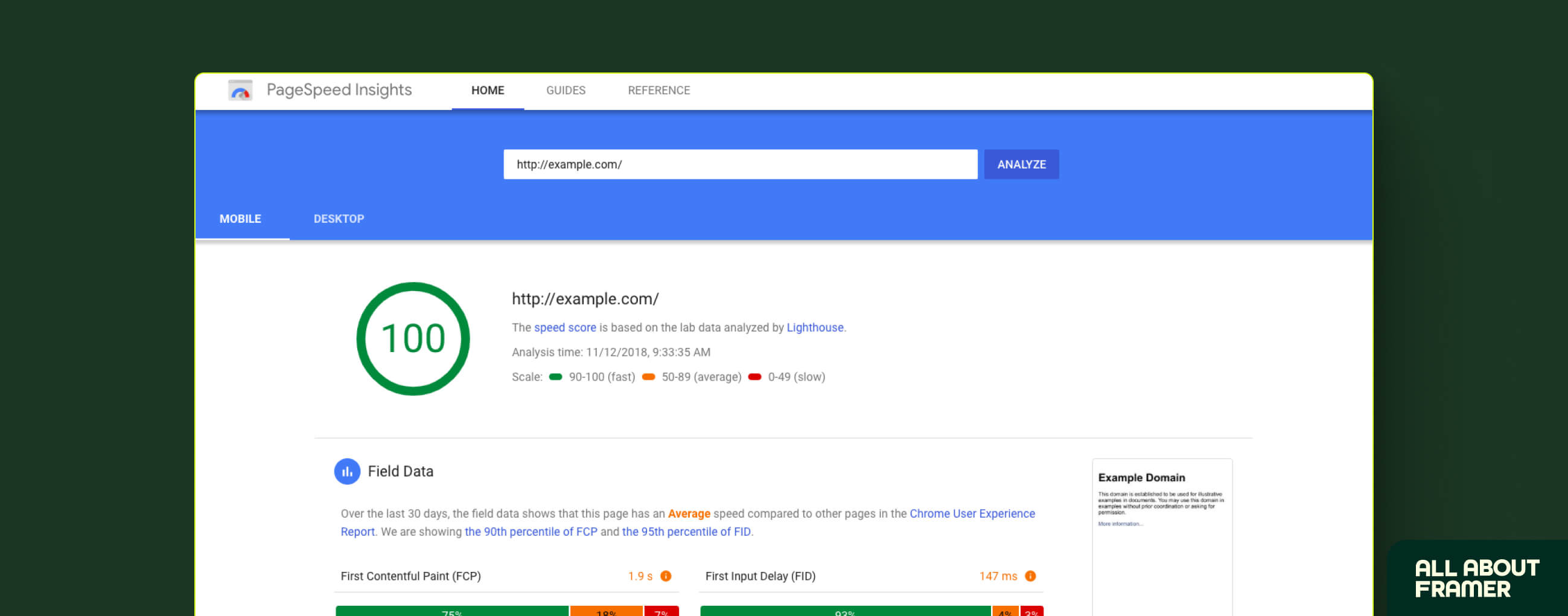
Test with Google PageSpeed Insights on mobile before and after launch. Target 70+ on mobile; 90+ is achievable on a well-optimised Framer site
Check Google Search Console → Core Web Vitals report 4–6 weeks post-launch for field data
A clean, disciplined Framer site can score 90+ on PageSpeed. A heavily animated one can score in the 40s. The ranking difference is measurable.
Risk 4: Deleting Content That Was Earning Your Rankings
This one is silent and sneaky.
You rebuild your site in Framer, it looks incredible, you launch — and then your rankings quietly slide over 4–8 weeks.
What happened?
You trimmed the copy.
The old page had 1,400 words. The new Framer version has a slick hero, three sections, and 180 words.
It looks cleaner. But Google was ranking the old page because of that content.
The keywords in the paragraphs, the FAQ section at the bottom, the topical depth that signalled expertise.
You removed what Google was rewarding you for.
The fix:
Before migrating, open Google Search Console and check which keywords each of your top pages ranks for. Note the search queries driving impressions and clicks.
Make sure those topics, keywords, and questions still exist somewhere on the rebuilt page.
You don't need to keep every word, but the topical coverage needs to be preserved.
Never sacrifice content depth for design cleanliness. You can have both.
Risk 5: Complex WordPress URL Patterns That Framer Can't Replicate
This one specifically affects WordPress migrations.
WordPress sometimes generates URLs that Framer simply can't match:
/2023/04/15/article-name(date-formatted archive URLs)/?p=123(query-based post URLs)/category/design/page/2(paginated archive pages)/tag/seo/(taxonomy archive pages)
Framer doesn't support these patterns natively. Which means redirects are mandatory, not optional.
The fix:
Build a URL mapping spreadsheet before you start.
Old URL in column A, new Framer URL in column B.
Set up 301 redirects in Framer's redirect manager before you go live. Use wildcard redirects for entire URL pattern families.
One important note: if you're on the Basic plan and need 301 redirect support right now, there are workarounds. Cloudflare (free plan) lets you set up redirect rules at the DNS level, which gives you proper 301 behaviour without needing to upgrade Framer.
Redirection.io is another reliable option. These aren't ideal long-term, but they're better than nothing while you sort your plan upgrade.
Risk 6: Accidentally Blocking Google With a Noindex Tag
This one is rarer but catastrophic when it happens.
Framer has a per-page indexing toggle in Page Settings. It's easy to accidentally leave pages set to noindex — especially if you were testing the site in preview mode and toggled it off during development.
A noindex page is completely invisible to Google. It won't rank. It won't even appear in Search Console.
The fix:
Before launch, go through every page and CMS template in Framer and confirm the indexing toggle is switched on.
Check your top 10 most important pages individually.
Submit your sitemap (yourdomain.com/sitemap.xml) to Google Search Console immediately after launch. This tells Google exactly which pages exist and should be indexed.
Beyond migration, avoid these 5 critical SEO mistakes when building your Framer site.
How Long Does SEO Recovery Take After Migrating to Framer?
If you do the migration correctly: 2–4 weeks for Google to fully recrawl and reprocess your site.
Some minor ranking fluctuations during this window are completely normal.
Most well-executed migrations stabilise at or above their previous rankings within a month.
If you miss something — broken redirects, missing metadata, content gaps — the recovery timeline stretches.
Expect 4–12 weeks for domain authority to fully restabilise. Serious mistakes (mass 404s, large-scale content deletion) can take 6–18 months to recover from. In the worst cases, they don't.
The lesson: invest an extra few hours in the pre-migration audit. It's worth infinitely more than months of recovery work.
Will Migrating to Framer Improve My SEO? (Yes, It Can)
Not just a possibilit but a realistic outcome for many sites.
Framer's pre-rendered HTML is easier and cheaper for Google's crawlers to parse than the JavaScript-heavy, plugin-stacked builds common on WordPress.
Sites that were previously held back by slow load times, bloated code, and poor Core Web Vitals scores often see genuine improvements after a clean Framer migration.
Specifically: if you're moving from a WordPress site running multiple heavy page builders, a caching plugin, multiple SEO plugins, and auto-playing media…a lean Framer rebuild with the same content can be a meaningful upgrade for both users and search engines.
That said if your old site had strong content depth, an established link profile, and well-structured metadata, a careless Framer rebuild can easily end up performing worse than what you had.
The platform advantage only shows up if the migration is done properly.
What Framer's SEO Still Can't Do (Be Honest With Yourself)
Being straight with you here — because you deserve the full picture.
Custom canonical URLs require the Enterprise plan.
Below that, you can't manually set canonical tags to tell Google which version of a page is the authoritative one. This matters for sites with duplicate content, multiple language versions, or URLs with tracking parameters.
Hreflang tags for multilingual sites must be added manually via custom code injection.
Not impossible, but not a built-in GUI — unlike some WordPress plugins.
Schema markup beyond basic types requires you to write JSON-LD and inject it via custom code blocks in Site Settings. Fully doable, just not a visual editor.
robots.txt customisation is limited. Framer auto-generates it, but granular crawler control requires workarounds.
For most portfolios, marketing sites, landing pages, and blogs, none of these are blockers. They matter more for large-scale, technically complex SEO operations.
The Framer SEO Migration Checklist (Do This Before You Touch Anything)
Before you start building:
Export all current URLs from your site (Screaming Frog or Google Search Console)
Export all metadata: title tags, meta descriptions, H1s, image alt text
Note which pages have backlinks (use Ahrefs free, Moz, or Google Search Console)
Benchmark current keyword rankings and traffic (screenshot GSC for comparison)
Identify your top 10 pages by organic traffic. These are your non-negotiables
During the Framer build:
Match your existing URL slugs exactly wherever possible
Set up 301 redirects for every URL that changes (Pro plan required, or use Cloudflare)
Transfer all metadata manually: title, description, OG image per page
Don't gut content. Preserve keyword coverage and topical depth
Set defined image dimensions on all visuals (prevents CLS)
Keep animations away from your hero heading and main image (protects LCP)
Check every page's indexing toggle is set to ON
On launch day:
Keep old site live until Framer is fully ready and tested
Submit your sitemap to Google Search Console:
yourdomain.com/sitemap.xmlRun PageSpeed Insights on your five most important pages. Fix anything below 70 on mobile
Test every 301 redirect manually with a redirect checker tool
Post-launch monitoring:
Check Google Search Console for 404 errors and crawl issues in the first week
Monitor keyword rankings weekly (not daily — daily data creates panic)
Check Core Web Vitals report in Search Console at the 4–6 week mark
Compare organic traffic week-over-week in Google Analytics
Frequently Asked Questions About Framer SEO Migration
Does Framer support 301 redirects for SEO?
Yes, Framer has a built-in redirect manager under Site Settings → Redirects. However, 301 redirects require the Pro plan or above. They're not available on the free or Basic plan. If you need redirects and can't upgrade immediately, Cloudflare's free plan lets you set redirect rules at the DNS level as a workaround.
Will my Google rankings drop after migrating to Framer?
Some minor fluctuation in the 2–4 weeks after migration is normal and expected. Google is reprocessing your pages. A well-executed migration (same URLs, full metadata, proper redirects) should stabilise at or above previous rankings within a month. A poorly executed migration with broken redirects and missing metadata can cause 10–30% traffic drops that take months to recover.
Does Framer hurt SEO because of JavaScript?
No. Framer pre-renders its pages as static HTML before serving them to visitors. Google's crawlers see clean, readable HTML, not JavaScript that needs to be executed. This is actually one of Framer's SEO strengths compared to client-side JavaScript frameworks that require Google to render the JS before indexing content.
How long does it take for a Framer site to rank on Google?
For a migrated site with existing authority: Google typically recrawls and reindexes within 2–4 weeks, with ranking stabilisation shortly after. For a brand new Framer site with no history: indexing can happen within days of submitting your sitemap, but ranking for competitive keywords takes weeks to months depending on content quality, backlinks, and competition.
Should I change my domain when migrating to Framer?
No, not unless you have a specific reason to. Your domain is where your accumulated authority lives. Changing domains during a platform migration doubles your risk. If you must change both simultaneously, use Google Search Console's Change of Address tool alongside comprehensive 301 redirects, and expect a longer recovery period.
Is Framer better for SEO than WordPress?
For marketing sites, portfolios, and landing pages: Framer's clean code, fast CDN hosting, and zero plugin overhead can genuinely outperform bloated WordPress setups. For content-heavy blogs with advanced SEO needs (complex schema, multilingual hreflang, custom canonicals): WordPress with a dedicated SEO plugin still offers more fine-grained control. It depends entirely on your use case.
Can Framer animations hurt my Google rankings?
Yes — if applied incorrectly. Entrance animations and scroll effects applied to your hero heading or main image can delay LCP (Largest Contentful Paint), which is a direct Google ranking factor. Keep animations away from your above-the-fold primary content. Test with PageSpeed Insights before launching, and aim for LCP under 2.5 seconds on mobile.
The Bottom Line: Does Migrating to Framer Hurt Your SEO?
No. Framer won't hurt your SEO.
A rushed migration with broken redirects, missing metadata, content gaps, and animation-heavy pages that fail Core Web Vitals will.
The platform is solid.
The technical SEO foundation is genuinely good.
Some sites improve their rankings after switching, because clean, fast code on a global CDN beats plugin-heavy WordPress every time.
But Framer doesn't do the migration for you.
You still have to carry your URLs, your metadata, and your content across properly.
Do that, and your rankings follow you.
Skip it, and you'll spend the next six months wondering what went wrong.
Take the extra few hours. Set it up right.